Jean Yeates Writing Prize 2026
Posted on September 10, 2026
Every year, the Jean Yeates Writing Prize provides an opportunity for our senior students to explore ideas through creative writing and to share their work with an experienced writer and editor. Coordinated by the Friends’ English Team, the competition is our longest-running school writing prize and honours Jean Yeates, a former Head of English and Head of Clemes who was known as an inspirational mentor during her 30 years of service at The Friends’ School.
The theme for this year’s prize was “KNOT”, with Years 11 and 12 students responding to the theme in a wide variety of ways through short stories, personal essays and poetry. As adjudicator Jane Rawson observed, the entries explored writers “struggling to untangle the knots” of their identities and their place in the wider world, while experimenting with different forms and ways of telling a story.
This year we congratulate Bahzi Nicholas, winner of the 2026 Jean Yeates Writing Prize for her poem Disappearing Tarn, and Caitlyn Cooke, who was awarded runner-up for her short story British-style satirical advertisement.
Jane Rawson is a Tasmania-based author, essayist and editor, and the current Managing Editor of Island magazine. In her work at Island, Jane regularly reads writing from emerging authors, although, as she explained in her adjudication video, she rarely encounters work from writers under 20. She was therefore particularly excited to read the perspectives and ideas of young writers from The Friends’ School.
Jane described Caitlyn’s entry as an ambitious and successful experiment with form. Inspired by a dream, the story explores Victorian-era women and errant parrots through the unusual format of a script for an insurance advertisement. Jane praised the piece as “witty, evocative, brilliantly surreal” and noted the clever use of knots throughout the story.
Bahzi’s winning poem, Disappearing Tarn, takes the natural world and the landscape of kunanyi as its starting point. Jane particularly admired Bahzi’s imaginative decision to place the reader inside the mind of the tarn itself, exploring not how people perceive this mysterious body of water, but how the tarn understands itself. Through what Jane described as a “beautiful use of imagery and empathy”, the poem reminds us that nature matters in its own right, whether or not it is visible to us.
Jane found choosing a winner difficult, congratulating all of the students who submitted their work. “Everyone who makes the effort to untangle the knots in their mind into words on a page has performed a mighty feat,” she said.
Jane was able to visit The Friends’ School on 2 September as part of the Senior School’s Stories in September writers festival, meeting with English and Creative Writing students and working individually with Bahzi and Caitlyn as part of their prize mentorship sessions. She spoke with students about their writing challenges, ambitions and the books they love, as well as the different approaches they are taking to their own creative work.
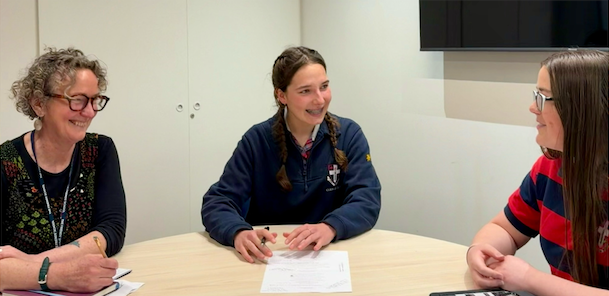
Reflecting on her time with the students, Jane offered an inspiring reminder of the importance of creative writing: “Every act of imagination is a small act of revolution.” By making up stories and imagining things differently, she said, writers are suggesting that the world does not have to remain as it is.
As winner of the Jean Yeates Writing Prize, Bahzi will have her name added to the honour board and receive a prize to the value of $200, generously donated by the Old Scholars.
You can hear Jane speak about this year’s theme, the student entries and her decision as adjudicator in the video below.
Bahzi’s winning poem, Disappearing Tarn, and Caitlyn’s runner-up story, British-style satirical advertisement, can be read below.
Disappearing Tarn
Suspended particles twirling, resting, sinking
Echo the sun’s beams
Reflecting, challenging, morphing.
Come dusk, when violets and lilac colour my surface
Mirroring the dancing skies behind kunanyi,
Twinkling balls of fire gradually light up the heavens.
They map my particles, and I map them.
We blink in and out of existence together, silently.
When my banks recede
It is not that I am tired, or empty.
People stop trekking to see me.
But this is when my luminescent bursts of life erupt beneath the rocks,
When mountain peppers ferment between my hands,
And when ancient water pools in a place so alone, so dark, so enclosed
But so quiet, so serene, so vibrant.
But there was one.
She would arrive on the wind,
So subtly that I barely saw the line between
Her flying hair and the acacia’s feathers.
She would not sit. She would not stand.
She merely drifted on a breeze I often could not see.
When she was gone I still felt the tug of
Her wild locks, her clouded eyes, her billowing cloak.
We were knotted together by something only the stars could see.
My stars and yours.
– 2026, Bahzi Nicholas (Year 12)
British-style satirical advertisement
A short story by Caitlyn Cooke
The black film screen flickers to life as a projected image changes from black to vivid white, blasting the film onto the pasty cloth screen. An establishing shot is used to present a scene from the Victorian Era, where a three storey sandstone building faces the camera, its windows look out over a vibrant green lawn, the grass freshly mowed. The sandstone building is likely an art museum which faces a large park. The camera pans out as ladies promenade in pairs down a fawn coloured gravel path, diminutive curved fences separate the path from the lawn with little signs indicating a message, ‘KEEP OFF THE GRASS’. Gentlemen walk by in morning and french coats, a few wear top hats, swinging long walking sticks in one hand, while others embrace a lady, arms coupled around each other, lovers walking peacefully as they politely make conversation enjoying the day’s clarity. The air is fresh and a chill breeze bites on everyone’s cheeks giving them a rosey glow. Yet everyone is dressed accordingly, in shawls, wraps and proper undergarments that knot annoyingly around their bodies, they appear ready for the day ahead yet have to pull the garments every so often to prevent tangles. A few tall English Oak trees are perched in the right hand corner of the frame, sprawling weeping beech trees have been trimmed into little knot-like spheres, only a few fresh tendrils loose, these ones appear slightly withered compared to the unknotted English Oak trees. Past the greenery the camera shifts towards the right as a fine lady in a large bell skirt and delicate hat walks into frame, in one hand she holds a purple parasol, in the other a lead, despite carrying the burden of holding something in each hand as a light wind shoots her parasol upward, she is poised. Audiences are drawn to look at the fawn gravel once again, attached to the leash is a vibrantly coloured parrot, it has lush green, red and blue feathers emphasising its handsome presence. The lady continues walking, passers-by promenade without noticing, their clothing also tangled around their figures, she is unaware that the vibrant specimen has outstretched its large wings and begun to peck at the knot attaching it to the leash. Through a close up shot, the lady stops and looks down, she has sensed the lightness in her left hand. The leash is now dragging in the dirty gravel, abandoned and untied. Panning upward through a Long shot, the clear blue sky is blinding, despite a few clouds remaining as a reminder of the fresh morning air. Noticing the bird begin to fly off into the horizon she calls out to another woman whom she does not know. In a pleading tone she asks “Please can anyone help me bring back my bird, he has gone, oh I am so sad, this is terrible”. The camera shifts further right, upon the gravel path the lady she was directing her question to walks into frame, she is dressed in similar bell skirt and full dress attire, unlike passers-by her clothes are neat and everything sits flatly on her figure, untangled, her smile radiates up to the top of her head, her hair is knotted tightly in a wispy gray bun. With an eased smile, she replies in an upper class accent, her tone is friendly like a grandmother speaking to a child who has just scraped their knee, “Of course darling, my bird can help get your bird back, he was trained as a messenger bird you know.” Just as this new woman speaks, the camera frame widens, bringing something else into sight. Down upon the helpful women’s side, is a red leash attached to her leash is a parrot, however upon further inspection from both the audience and woman whose parrot has flown away viewers notice this woman’s bird is dead. Its feathers are held tight at its sides with shrivelled claws, yet the woman is in a haze. She believes her bird is fine, and can guide the other bird safely back to the lady, as if it really was once a trained messenger parrot. The poor lady begins briskly walking, with leash in hand, frantically she picks up speed, the fresh morning air lightly brushing her hair away from her ears. She looks whimsical yet slightly insane. The camera zooms out more in order for the audience and women to now notice a kite dragging behind her. The woman’s bird is attached to both lead and kite, unfortunately this creates a knotted mess on the gravel path. However, despite this the kite begins to take flight before plummeting and attempting to take off again. Eventually the old woman runs out of breath, it has hit her that the kite is not taking flight and hence her parrot has not taken flight either. The lady whose bird is now away in the distance out of sight looks at the elderly woman in both pity and annoyance. Initially dazed and confused she has a realisation of her own, her bird is indeed not being ‘rescued’ and the other lady’s bird is certainly not taking flight. The film screen goes black, words flash in deep white typewriter font. ‘When life goes unexpectedly wrong, don’t let yourself or the ones you love be TIED down, with life insurance you can protect the ones who live, don’t continue to pass by uninsured, avoid the knotty complications of death and fly to the heavens debt free.’