2026 Peter Jones Peace Prize
Posted on August 6, 2026
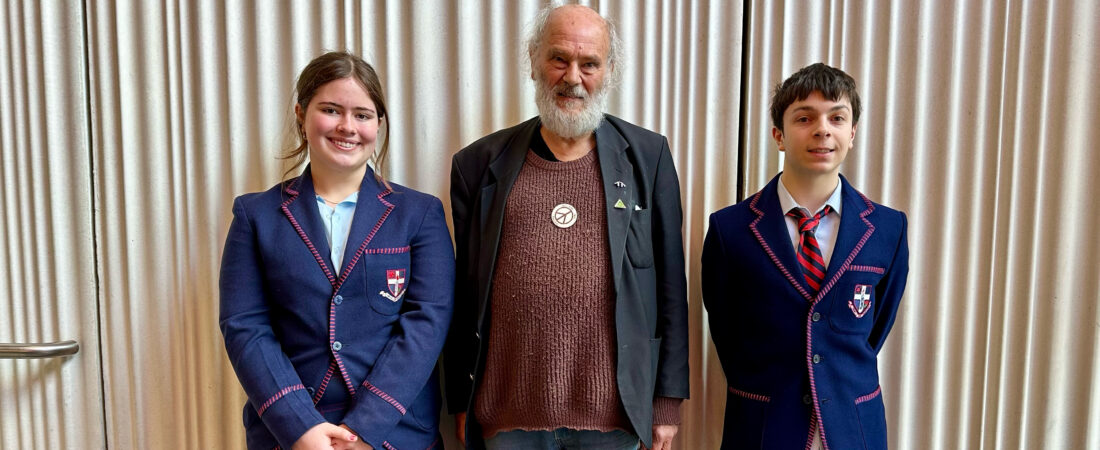
The Peter Jones Peace Prize is one of the School’s annual writing prizes, established by then-Co-Heads of English, Sarah Walker and Sarah Cupit, in 2014. A prize–with a focus on the Quaker testimony of peace–it was named for, and in honour of, a Quaker who “walked his talk”, and was not only an affirmation of the School’s values but allowed students to engage in a form of peaceful protest: writing.
The Quaker who inspired the prize was Peter Jones. Peter is a life-long peace and human rights activist and was a long-serving, much loved, teacher on staff at Friends’, teaching (among other things) Comparative Religion, Asian Studies, Humanities and English. Today, Peter continues to serve the wider community teaching for the University of the Third Age (U3A: an international movement) and at the Migrant Resource Centre, here in Hobart.
Peter provides the prompt–or the theme–for each year’s competition. This year, he chose a quotation from Albert Einstein, from a speech Einstein made to the New History Society in New York in 1930:
“Peace cannot be kept by force; it can only be achieved by understanding.” – Albert Einstein
This speech advocated for militant pacifism and international disarmament post-World War I. In our current geo-political climate, nearly 100 years later, Einstein’s words are still relevant and it is easy to see why Peter chose this particular quotation for this year’s competition prompt.
In his speech for the prize-giving at our Senior School Assembly on 29 July, Peter wore his PEACE symbol badge: one of the first ever made featuring the now-familiar peace symbol. We learned that Peter’s parents would take him to peace rallies and protests when he was a young boy in the UK and Peter told us of the origins of the peace symbol: the one which we most readily relate to 1960s counter-culture and the anti-war movement of that era. We learnt that the design of the iconic symbol is a graphic representation of semaphore signals for the letters N (standing here for Nuclear) and D (standing here for Disarmament), with the circle representing the world. Whilst most of us know this symbol is about peace, we might not necessarily know that its genesis was in the nuclear disarmament movement of the 1950s.
During the holidays, the adjudication panel–including Peter Jones and writer and teacher Danielle Wood–met to consider the large number and wide variety of entries in this year’s comp.
For the way in which it consistently and thoughtfully addressed the prompt, the panel highly commended and chose as the winning entry Ivy Salmon’s essay titled, Force, Understanding and Peace.
For the way in which it simply, yet effectively, addressed the prompt, the panel also commended Alex Giannakopoulos for his fable-like poem titled, The Men of Two Towers.
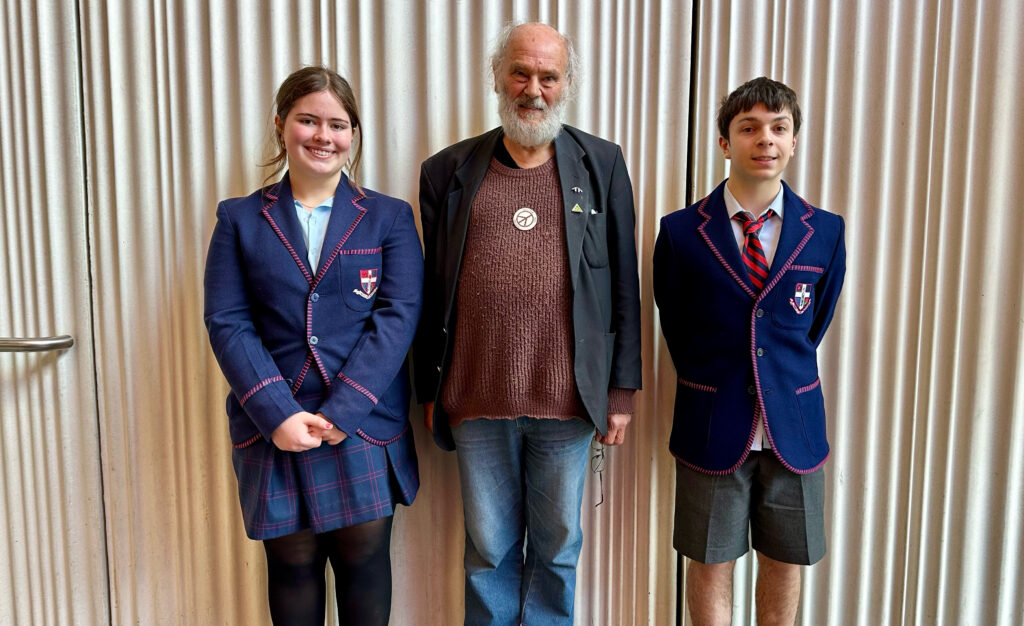
Both these responses can be viewed via the links below.
Winning Entry – Force, Understanding and Peace by Ivy Salmon
Runner-up Entry – The Men of Two Towers by Alex Giannakopoulos
Thanks to all the students who entered this year’s competition. Congratulations to Ivy and Alex on their achievement and heart-felt thanks to Peter Jones.